AI Café at Copenhagen Airport: When Learning About AI Begins With Safety and a Cup of Coffee
Copenhagen Airport has created a shared space for curiosity and digital development. The AI Café builds a culture where employees learn, experiment and feel confident using AI. The message is clear: AI is anchored in people, not technology.
When Copenhagen Airport launched its AI Literacy programme in spring 2025, the goal wasn’t just to equip employees with new digital tools. It was to change the way people talk about technology.
Since then, more than 600 employees have completed AI and Copilot training across more than 40 departmental courses, workshops, and AI cafés. Around 600 now actively use Copilot Chat every week – and what began as a technological upskilling initiative has evolved into a cultural movement.
“We believe that if we are to succeed in making AI a natural part of how we work, we need to do it together. It requires psychological safety. You need to dare to ask questions, share doubts and learn together,” says Christian Michel T. L. Saugman, CIO and one of the driving forces behind the initiative.
The strength lies in the recognition that digital maturity is not created through demands, but through community. When employees feel safe experimenting, learning and innovation can grow from the bottom up. This approach sets Copenhagen Airport apart from many classical digitalisation projects where the focus is often on implementation rather than adoption.
The AI Café as a Learning Laboratory
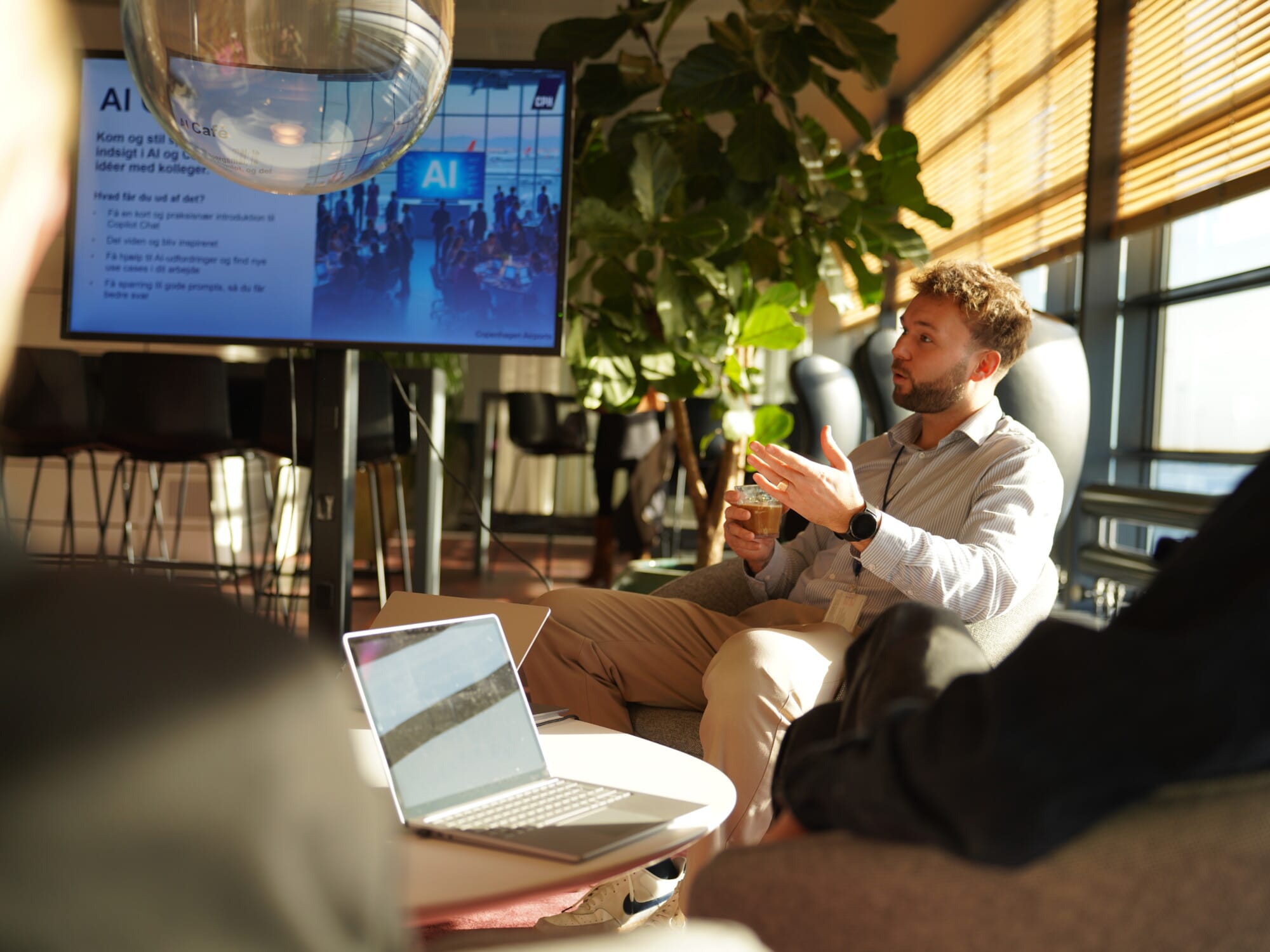
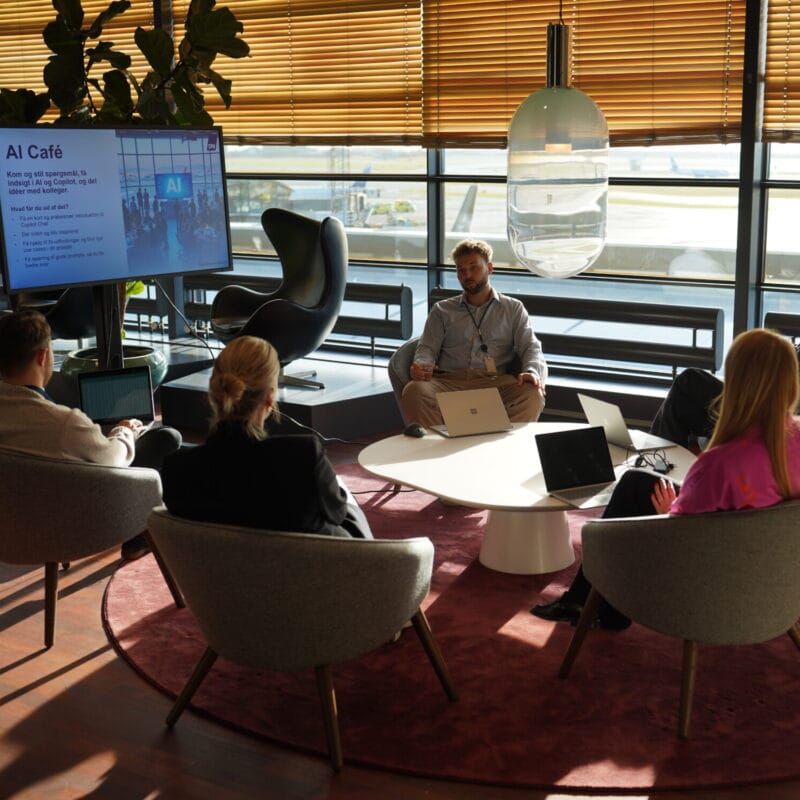
The AI Café functions as an open forum where employees can drop by without signing up. A large screen with the AI logo signals that this is a space for learning and exploration. Some stay for ten minutes to get help with a prompt. Others stay longer to talk about ethics, data security, or practical use of Copilot.
“The AI Café has lowered the barrier for those who don’t see themselves as technologically strong. Here you can ask the ‘stupid questions,’ discover new ways of using the tools – and feel that you’re not alone,” Saugman explains.
This reflects Copenhagen Airport’s learning philosophy: AI competencies are best developed in real life, close to actual work tasks. This aligns with Digital Dogme’s understanding of practice-based upskilling, where learning happens through application, reflection, and dialogue. All three elements come together in the café.
Small everyday interactions make a big difference. When an employee discovers that Copilot can structure meeting notes or generate draft reports, the technology suddenly becomes concrete and relevant. Each small success sparks curiosity and fuels the broader culture shift.
From Resistance to Mastery
Perhaps the most remarkable outcome is how the AI Café has transformed attitudes. Where uncertainty and scepticism once prevailed, curiosity and willingness to learn are now taking over.
“We find that the best questions often come from those who are most sceptical. When someone asks: ‘What if Copilot is wrong?’ – it opens a conversation about ethics and responsibility. That dialogue makes AI more human,” says Saugman.
Here, the café becomes not only a learning space but also a space for reflection. Copenhagen Airport doesn’t dismiss concerns; it uses them as a lever for responsible AI adoption. It sends a strong signal: taking AI seriously also means taking employee concerns seriously.
This perspective is crucial at a time when many organisations struggle with trust and transparency around AI. Copenhagen Airport shows that ethics doesn’t need to be an appendix to technology – it can be part of everyday conversations.
A Movement That Continues to Grow
Demand for the AI Café is rising. As more employees gain access to the licensed version of Copilot, weekly cafés are now being planned. The aim is not only to maintain learning but to create a self-reinforcing movement where employees inspire each other.
“It’s not just about using AI. It’s about taking ownership of it. When people realise that they can shape the technology to their own needs, it becomes part of their work life – not an add-on,” Saugman continues.
The point is clear: ownership is the highest form of competence. When employees begin developing their own solutions – small automations, personal assistants, prompts tailored to their tasks – the organisation moves from learning to innovation.
This is where Copenhagen Airport sets a benchmark: digital transformation shouldn’t be top-down, but grow from the people on the ground.
Advice for Others: Start Small, but Start Together
Lessons from Copenhagen Airport highlight three key insights for other organisations:
- Create space for curiosity – AI shouldn’t be introduced as a requirement but as an invitation. An open format like the AI Café makes it legitimate to ask questions and learn from each other.
- Anchor learning in everyday work – The best results arise when employees try AI directly on their own tasks. Real learning happens in practice, not in PowerPoints.
- Put culture before technology – Digital maturity starts with psychological safety. When people dare to experiment, they also share knowledge – and that creates momentum.
Or as one employee put it:
“I thought AI was about machines. Now I can see it’s about us.”
This sentiment captures the essence of Copenhagen Airport’s approach. It’s not the technology that creates change – it’s the conversations, courage, and community surrounding it.
The Perspective: Everyday Life as a Learning Arena
The AI Café has made AI a part of everyday life – in the canteen, meeting rooms, and hallways. People talk about what works and what doesn’t. This fosters a culture where technology becomes demystified and learning happens continuously, not just in formal training sessions.
Experience shows that AI creates real value when it connects with job satisfaction and professional pride. Copenhagen Airport demonstrates that digital development doesn’t require grand gestures. It starts with a table, a cup of coffee, and a simple question:
How can AI make my day a little easier?
Read more