Business Academy Copenhagen: AI personas - an alternative dialogue about experience, behaviour, and capabilities
The AI transformation is full of hope and optimism, but professionals worry about what they can do and can't do with AI, and when they are competent AI-users. A personaworkshop can open up the dialogue in a safe way.
At Business Academy Copenhagen (Erhvervsakademi København, EK) we conduct research in AI, among other things through the project AI in Action. As part of this research project, we held a workshop in November 2025 aimed at uncovering the experiences that make the use of AI meaningful for IT developers. We chose the persona format because it allowed us to explore experiences, behaviors, and attitudes through fictional user profiles. This created a freer dialogue among participants, who were recruited from larger Danish companies via LinkedIn.
In this workshop, we focused on IT developers, but the format can be applied to all professional groups. It can also make good sense to mix employees from different disciplines if the purpose is to gain a broad perspective on AI profiles and competencies.
From user roles to protopersonas
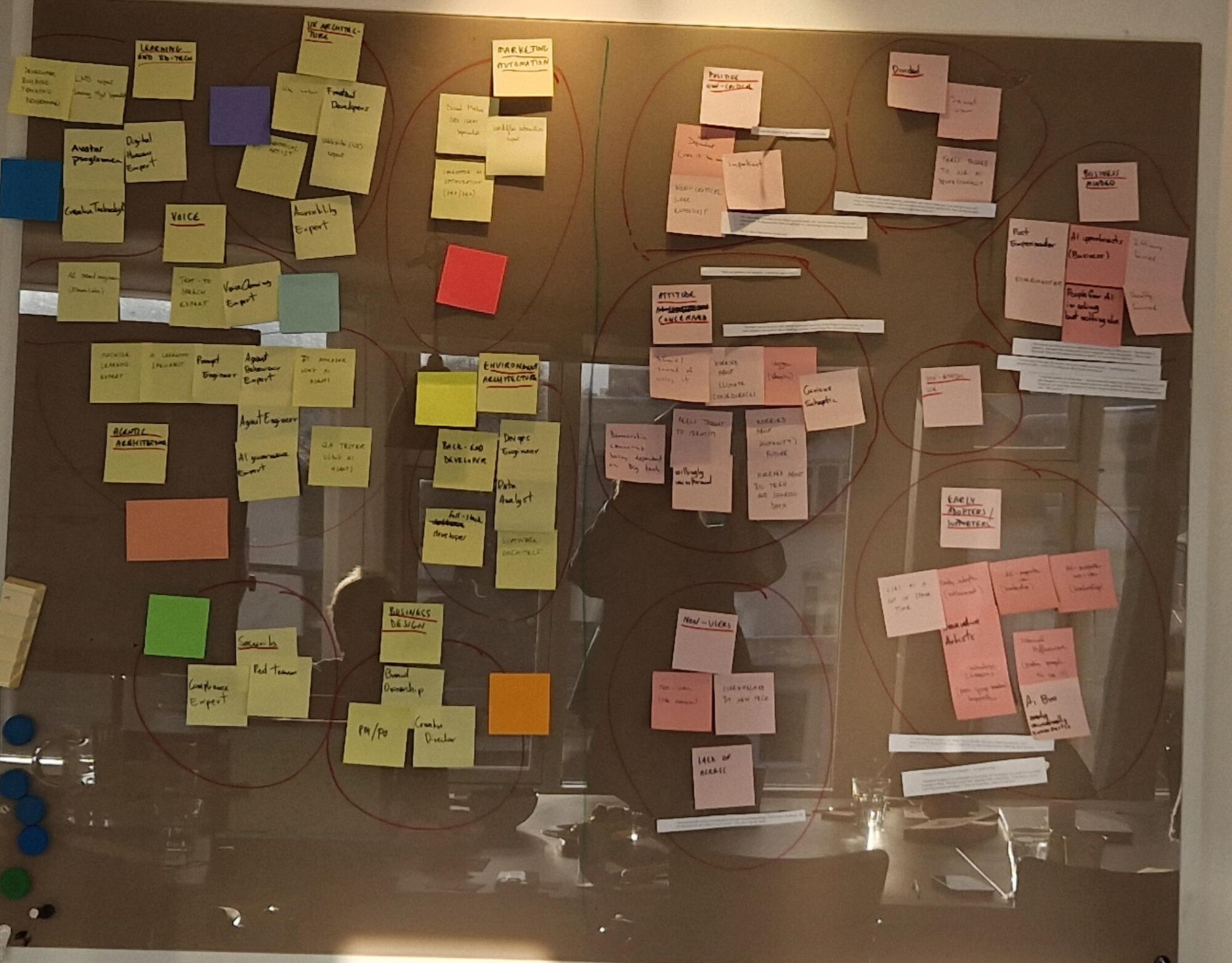
We began by brainstorming AI user roles. A user role is an ultra-short description of an AI profile. Examples include “prompt engineer,” “agent behaviour expert,” “vibe coder,” or “workflow automation expert.” The user roles that emerged from the initial brainstorm were grouped into clusters of related roles, and in the end we had 7 clusters with a total of 47 roles. These 7 clusters constituted our protopersonas.
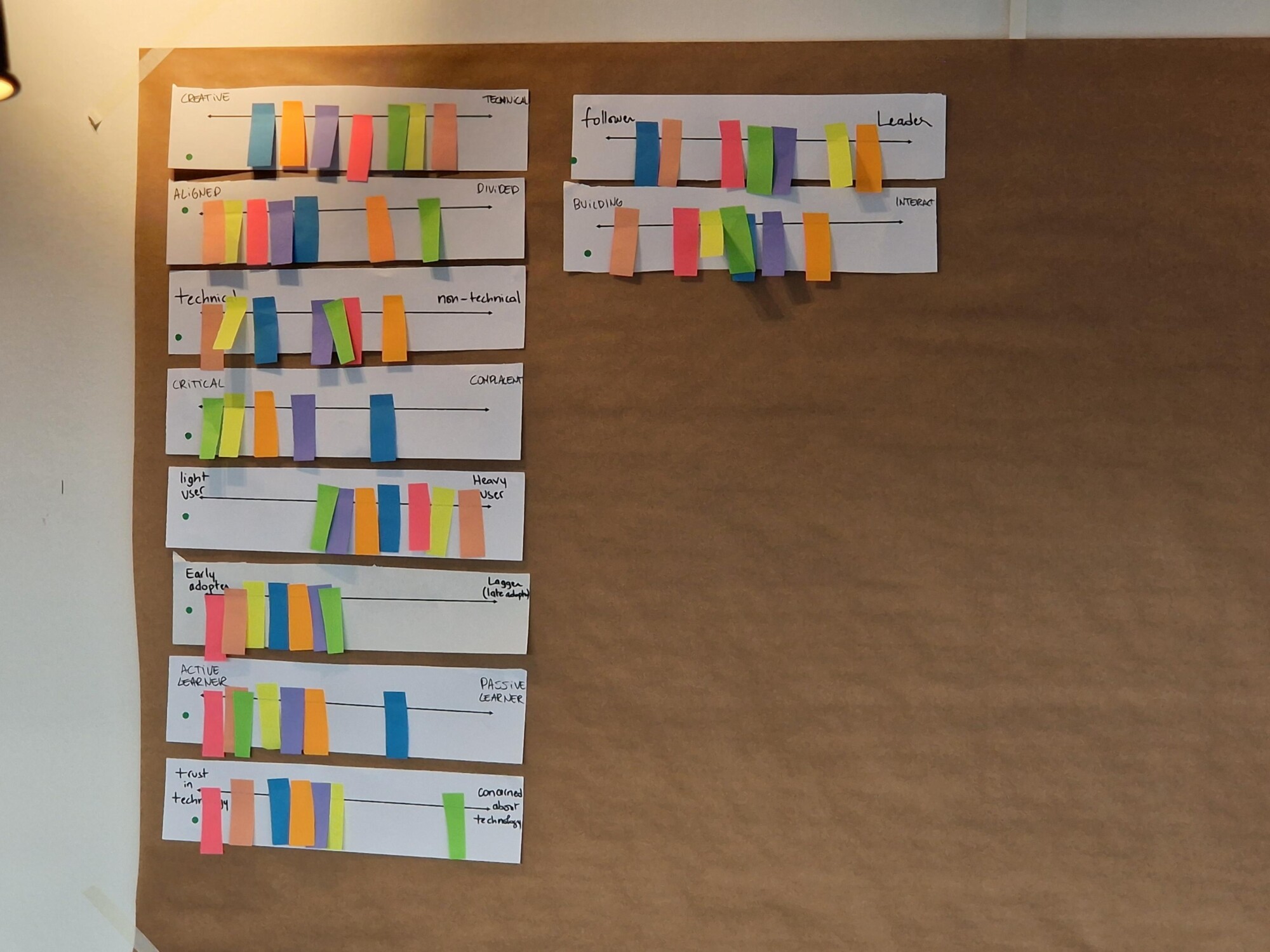
We then conducted the same exercise, this time focusing on behaviors and attitudes. This resulted in 33 types, such as “technology champions,” “secret user,” and “curious sceptic.” Based on these 33 types, the participants developed 10 dimensions on which we could map our protopersonas.
Examples of dimensions were:• “trust in technology <> concerned about technology”• “building <> interacting”• “light user <> heavy user”
The purpose of mapping the protopersonas was to obtain a visual representation of how they were distributed across the dimensions, and to see whether some of them overlapped to such an extent that they could be merged.
Personas reveal shifts in professional boundaries
The participants selected three protopersonas, which were developed into full personas. The protopersona titled “Environment architecture” (which included, among others, the user roles “back-end developer” and “data analyst”) was merged with the protopersona “UX architecture” (which included, among others, “front-end developer” and “graphical AI artist”), as with the emergence of AI these two areas can increasingly be handled by the same profile. A graphical profile can vibe-code and thus move into the back-end developer’s domain, while the back-end developer can move into the graphical domain through AI-generated user interfaces. The two other protopersonas that were developed were “marketing automation” and “agentic architecture.”
Personas must feel like real people to engage
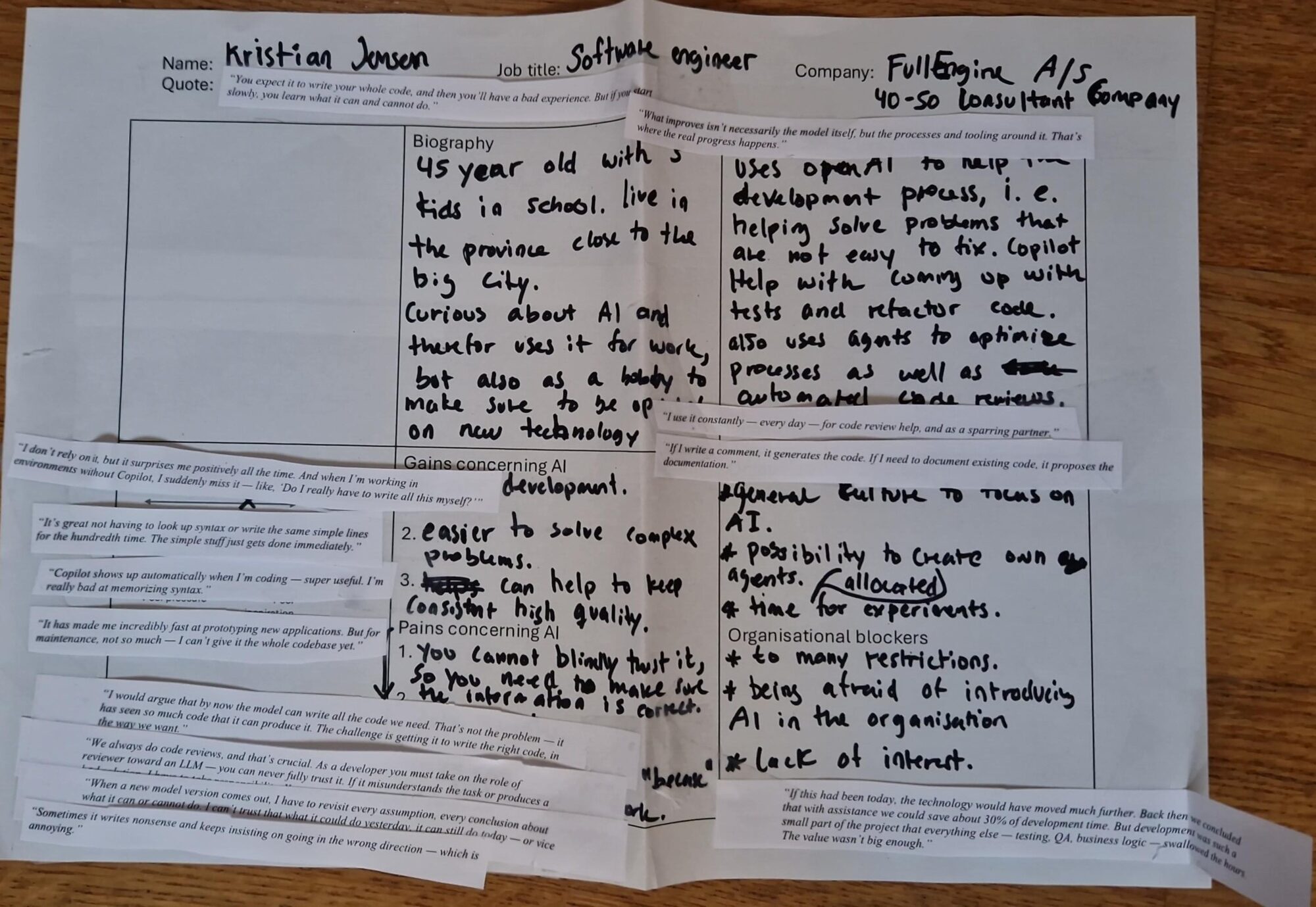
Lene Nielsen, Associate Professor at the IT University of Copenhagen and the first person in the world to write a PhD on personas, emphasizes that personas should not be archetypes or stereotypes, but should feel like real people in order for us to empathize with them. For the workshop, we used a persona one-pager that is adapted to the project, but contains roughly the same building blocks each time:
• Persona name, job title, company, quote• Image• Biography (demographics, knowledge of AI, attitude toward AI, AI in leisure time)• AI usage context (tools, tasks in general, software development)• AI profile (positioning on the 10 dimensions)• Pains and gains related to AI• Organizational enablers and blockers
Personas are a dialogue tool
The process of developing the personas is just as important as the final result. The negotiation among participants in the workshop can lead to new insights. We observed that several of our protopersonas had a headline containing the word “architecture.” With AI, architecture becomes an important capability, whether one works with cybersecurity, software development, or marketing automation. We also saw that different capabilities can increasingly be handled by the same profile, as illustrated by the example of UX versus back-end development.
What promotes and what inhibits
Through the description of the personas’ pains and gains in using AI, we can get close to individual motivation as well as concerns or barriers. Organizational enablers and blockers can uncover structures within the organization that either promote or inhibit the adoption of the technology. A recurring theme across the three personas was that time allocated during working hours could promote the adoption of AI, while too many restrictions were inhibiting.
What can companies use a persona workshop for? • Dialogue about AI on neutral ground. By developing fictional profiles, participants can discuss difficult topics without making it personal.• Making visible the different needs for skills and skills development across functions. A highly skilled AI user in marketing will have a different profile than a software developer who is a highly skilled AI user.• As a starting point for mapping capabilities. Some capabilities will be new, others will remain but within a different organizational setup. The personas and user roles can help uncover a landscape whose contours we are only now beginning to discern.• As a dialogue tool in a broader employee group. Are we mostly “Christian” or “Sophie” on our team? Or are we not represented by the personas at all—perhaps we were overlooked?
If this has inspired you to conduct your own persona workshop, you are welcome to reach out to us at Business Academy Copenhagen (Erhvervsakademi København, EK). Contact Kirsten Grønborg at kmg@ek.dk.
Read more